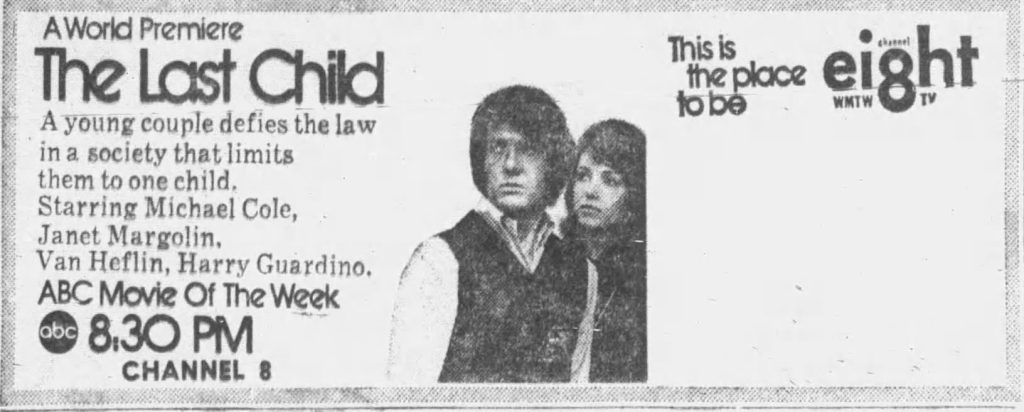
“Nobody Lives forever.” Neither would anyone want to live forever in a dystopian future where government controls every aspect of a citizen’s life – including the ability to reproduce. Considered to be a controversial made-for-television movie for its time, “The Last Child” (1971) explores the consequences of overpopulation, dwindling resources, and draconian laws which prohibit women from giving birth to more than one infant, even if her first infant died in infancy. Directed by John Llewellyn Moxey (City of the Dead, 1960) and written by Peter S. Fischer, “The Last Child” was an ABC Movie of the Week produced by Aaron Spelling which stars Michael Cole (The Mod Squad 1968-1973) in his first film appearance and Janet Margolin (David and Lisa, 1962) as Allen and Karen Miller, a young couple who are about to become parents for the second time after their first child died only a few days after birth.

The story opens with a ground’s eye-view of the middle of New York City: tall gray skyscrapers, dull and drab, echoing those in Fritz Lang’s dystopian 1927 “Metropolis”. A title appears across the screen with the words “Sometime in the not-too-distant future”. As the camera shot moves from the skyline to the ground, massive crowds of people can be seen walking through a building. Police are everywhere. There are signs on the wall as they move along: “Health Food”, “Assassin of Youth”, “To Downtown Trains”. A woman is walking against the crowd holding a young blond-haired boy by the hand. She temporarily loses him before calling out his name. A kind man (Cole) standing nearby off to the side gently picks up the boy who spots his mother as a policeman stands next to him. The boy is reunited with his mother, who is wearing a full-length overcoat. The policeman asks her to open her coat, which is hiding her maternal condition. The policeman asks to see her government-issued identity card, but she wants her son back, who is still being held by Cole. A blond-haired man starts arguing with the policeman as the woman is shuffled away by another policeman. The woman is arrested simply for being pregnant – while already having one child. Headed in the direction of the Population Control Enforcement Department, which is led by Ed Asner (“The Mary Tyler Moore Show” 1970-1977), who portrays a hard-nosed authoritarian policeman named Barstow, the woman will face one of two options for her pregnancy, neither which ends up positive for her or her future child. Welcome to New York City, the most populated city in the United States with several hundred thousand citizens.
Allen Miller and his wife Karen live in a high-rise in the city, as do the majority of New York City citizens. Karen is pregnant too, after losing her first child who died in infancy at only fifteen days old. The couple commemorates what would have been their daughter Ellen’s first birthday. They are preparing to have dinner with Karen’s brother Howard Drumm (Harry Guardino). While visiting, the discussion at Howard’s apartment turns philosophical about the present-day United States, given the dwindling natural resources and severe overcrowding. Howard admits that “Nobody lives forever”, even though science is advanced enough to create human immortality. Immortality is not considered desirable in a severely overpopulated world. To make matters worse, Howard holds an executive position with the government, which could be endangered if Karen has another baby. The draconian laws do not permit for the birth of a second child, even if the first child died in infancy. Considering himself instead of her husband as being responsible for his sister, the narcissist Howard does not give up in discouraging her from having the baby. Allen, on the other hand, is not afraid to challenge the government’s one-child policy in this special case.
When Margolin is arrested for her pregnancy while grocery shopping at a city owned store – the Overpopulation Police really are everywhere women might be seen in public – she is then assigned to Dr. Young (Ivor Francis), to advise her of the solutions, neither of which she nor her husband Cole desire. Dr. Young goes into her medical history, asking why she did not receive the mandatory sterilization after the birth of her first baby a year ago.
It is not until Allen and Karen head up to Canada to safely have the baby. While on the train, they meet retired Senator Quincy George (Van Heflin), resident of Dorchester, Massachusetts who still has some pull with the government. George understands the human condition of birth, life and death, telling the couple that he lost all three of his sons to the wars in southeast Asia, a reference to the Vietnam War still going on at the time this movie was made. George eventually shelters the couple at his home before they can continue traveling north to Canada. He even gives the couple the name of a political reference in Canada who will grant them refugee status. As the Population Control police catch up with the couple and their present location, they have no choice but to be on the run with Howard driving them to the border, leading to a climactic ending.
Despite the Socialist overtones in “The Last Child” – Janet Margolin’s character is seen shopping at a city-owned grocery store – healthcare is not socialized. In fact, healthcare is prohibited to anyone aged 65 and older, as is Van Heflin’s character, who is diabetic. Because of his status, however, he still has access to the healthcare he needs for his medical condition. What remains unique to the movie’s script is that there is no usage of the “a” word – abortion – which was still somewhat controversial back in the early 1970’s. The government carefully tracks everyone’s motions and movements through the required identity card issued by the government. Even the made-for-tv movie trailer for “The Last Child” received criticism for the way the government is portrayed, according to an interview with Aaron Spelling in The Houston Post, Houston, TX, October 5, 1971. Notably, “The Last Child” is the first screenplay written by Peter S. Fischer, which enabled him to make a career switch from editing and publishing a magazine on cars to writing for television series and movies.
Harry Guardino’s performance stands out as the concerned brother to a pregnant Janet Margolin. He admits his fear of the government to the Millers and really believes that being the property of the government and playing it safe in order to protect his hide is the best way to live in the futuristic United States. Compared to Guardino, the characters portrayed by Cole, Margolin, and Heflin still believe that government should not interfere with the lives of citizens. Support from Ed Asner, Ivor Francis, Kent Smith, Michael Larrain, Philip Bourneuf, Victor Izay, and Barbara Babcock round out the cast. Van Heflin’s final film role as a humanitarian was fitting for the Oscar winner (“Johnny Eager” 1943) before his death at the age of 62 in July, 1971, after the movie was filmed but before it was released in October that year.
According to an article on the movie in The Daily Herald, Provo, UT, October 4, 1971, “The Last Child” takes place in 1994, a year which may seem very distant to 1971 and deep in the past in present-day 2026. Nominated for a Golden Globe award for “Best Movie Made for TV” in 1971, it is the story and acting which make up for any special effects and visuals although it should be noted that the interiors of the apartments, police station, medical offices are as drab and sterile as the exterior gray skyscrapers dominating the New York City landscape. “The Last Child” explores the consequences of overpopulation and dwindling natural resources as described by Thomas Malthus, such as signs everywhere in the movie reminding people to conserve water. Food is only available through city-owned grocery stores in New York City, not an uncommon concept in 2026. While the movie was released in 1971, it was during the late 1980’s through 1990’s when there was a population explosion, largely due to population doubling since 1967, which prompted major publications like the New York Times (December 8, 1998), Time magazine (January 2, 1989), and American Psychologist (May 2000) to publish major articles on overpopulation. Somewhat predictive of other nations also experiencing extreme overpopulation, China established their one-child policy of 1979 to 2015.
Considering its overlooked legacy, “The Last Child” is a movie worth viewing for its contribution to the larger body of dystopian film and the real-life consequences of overpopulation on a global scale.
Image Credit: Unknown artist, “Little Blue Eyes” by Anonymous, London: Seeley, Jackson, & Halliday, 1875. Old Book Illustrations.

Zindbar Admin
You May Also Like